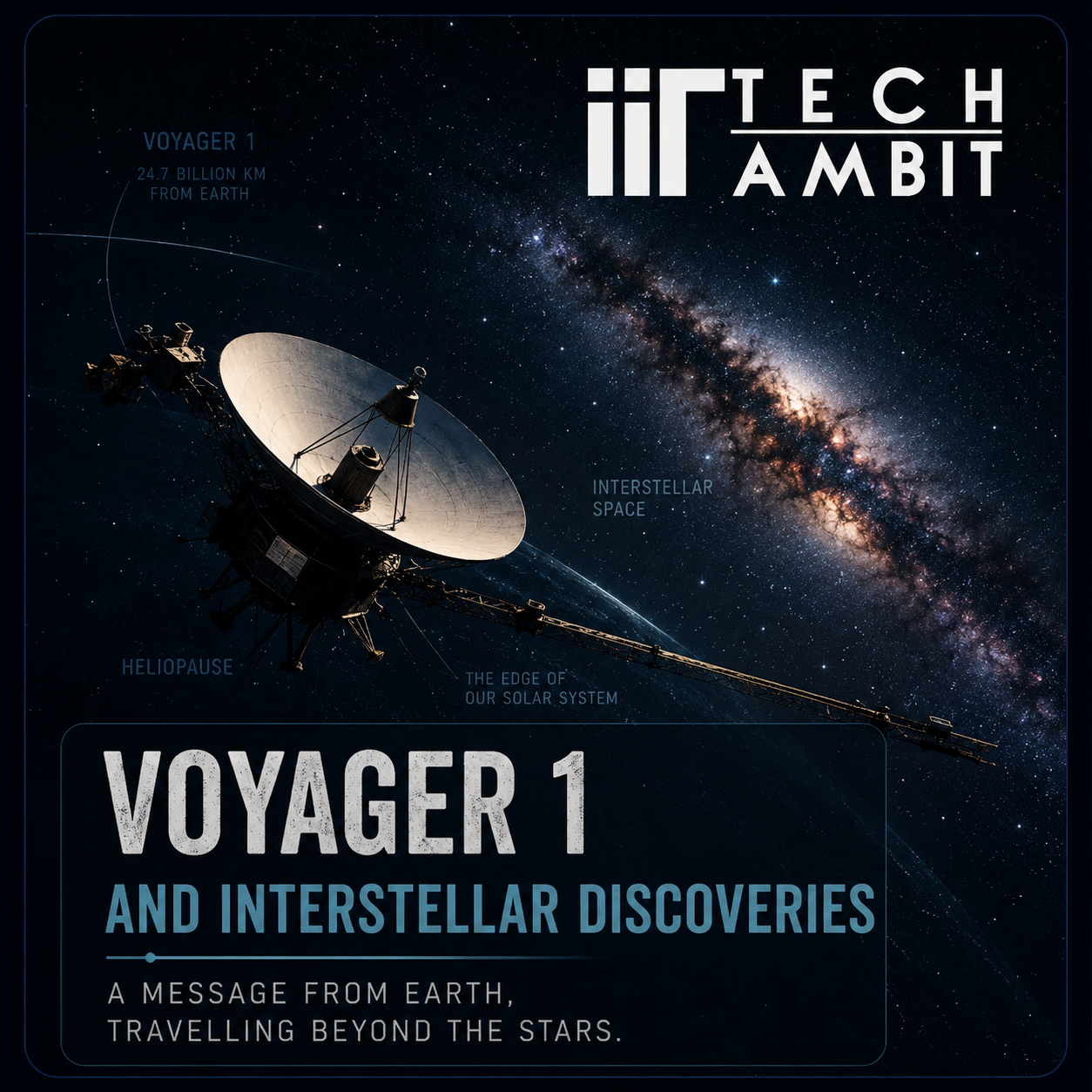
Somewhere in the darkness beyond Pluto, beyond the frozen edges of our Solar System, beyond the reach of sunlight strong enough to warm metal, a tiny spacecraft continues moving silently through space.
It carries no astronauts. No advanced AI. No futuristic engines. Just a weak radio signal, a fading power source, and a golden record filled with sounds from Earth, with hope of meeting someone which is unknown to humankind.
That spacecraft is Voyager 1 — the most distant human-made object ever created.
At this very moment, while students rush through assignments, satellites orbit Earth, and cities glow beneath monsoon clouds, Voyager 1 is traveling alone through interstellar space nearly 25 billion kilometers away from humanity. Its signals take more than 22 hours to reach Earth, moving at the speed of light. In a strange way, when scientists communicate with Voyager, they are talking to the past.
And yet, almost fifty years after its launch, Voyager 1 continues to send back information from a region no human being has ever seen. The story of Voyager is not merely a story about space exploration. It is a story about curiosity itself.
The grand tour of The Outer Planets
In the early 1970s, scientists at NASA noticed something extraordinary. A rare planetary alignment was about to occur — an alignment that happens roughly once every 176 years. During this event, the outer planets of the Solar System would line up in such a way that a spacecraft could use the gravity of one planet to slingshot itself toward the next.
This technique, known as gravitational assist, would allow a single mission to explore multiple planets using minimal fuel. The physics behind this maneuver relies on conservation of momentum and orbital mechanics. The gravitational interaction can dramatically increase spacecraft velocity without consuming additional propellant.
Using “Orbital velocity relation and carefully calculated trajectories”, NASA realized it could attempt something unprecedented: a “Grand Tour” of the outer Solar System.
Thus, Voyager 1 and Voyager 2 were born. Ironically, Voyager 2 launched first on August 20, 1977, while Voyager 1 launched slightly later on September 5, 1977. However, Voyager 1 followed a faster trajectory and overtook its twin spacecraft.
At launch, nobody expected these missions to survive for nearly half a century. Most engineers considered four years ambitious. Today, Voyager continues operating after almost fifty years in space. That alone feels almost impossible.
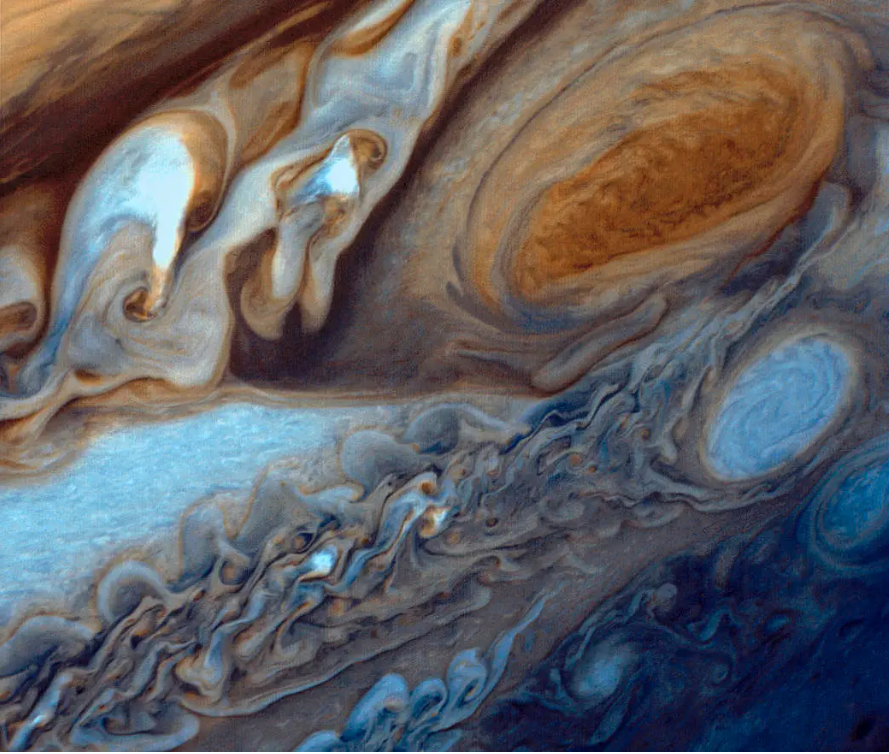
When Voyager 1 first approached Jupiter in 1979, humanity witnessed the giant planet in unprecedented detail. Before Voyager, Jupiter existed mostly as a distant object seen through telescopes. But suddenly, detailed images began arriving from space.
Scientists observed violent storms larger than Earth itself swirling through Jupiter’s atmosphere. They captured high-resolution images of the Great Red Spot — a gigantic storm that has existed for centuries.
IO: The moon that changed Planetary Science
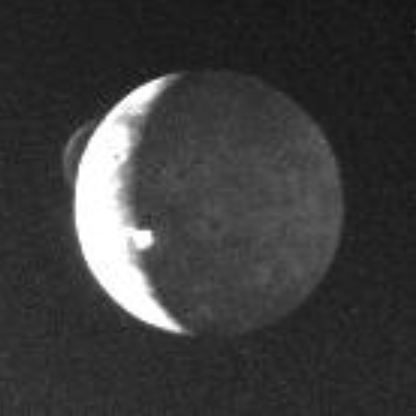
But Voyager’s most surprising discovery was not on Jupiter. It was on Io. Io, one of Jupiter’s moons, appeared at first glance like a frozen, lifeless world. Yet Voyager detected something shocking: active volcanoes erupting across its surface.
This was the first time active volcanism had ever been observed beyond Earth. The discovery transformed planetary science overnight.
Until then, scientists believed distant moons were geologically dead. Voyager proved otherwise. For perhaps the first time, humanity truly realized how dynamic and strange the Solar System actually was.
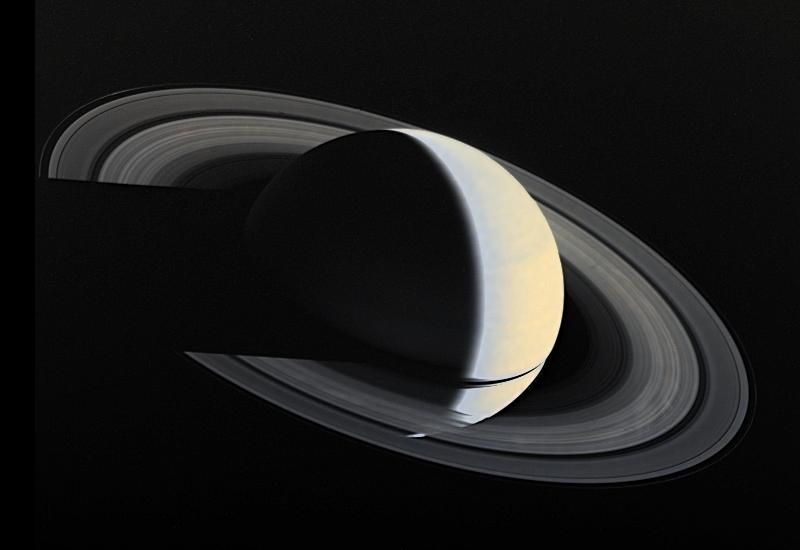
Then came Saturn. Even today, some scientists consider Voyager’s Saturn flyby among the greatest moments in space exploration history. The images transmitted back to Earth revealed breathtaking details of Saturn’s rings — delicate structures composed of ice and rock particles orbiting the planet in extraordinary patterns.
But once again, Voyager’s greatest discovery came unexpectedly. Titan, Saturn’s largest moon, appeared hidden beneath a thick orange atmosphere. Scientists became fascinated immediately because Titan possessed something extremely rare for a moon: a dense atmosphere rich in nitrogen. Decades later, future missions would discover rivers and lakes of liquid methane on Titan’s surface.
A moon with weather. A moon with rain. A moon where chemistry behaves almost like a distorted version of Earth. Voyager had shown humanity that the Solar System was not merely a collection of rocks orbiting the Sun. It was filled with worlds — strange, active, and mysterious.
But Voyager’s most important journey began after it completed its planetary mission. Instead of shutting down, the spacecraft continued traveling outward toward the edge of the Solar System itself. To understand why this matters, imagine the Solar System not as a simple collection of planets, but as a giant bubble created by the Sun. The Sun constantly emits charged particles outward in every direction through something called the solar wind.
Eventually, far beyond Pluto, this solar wind weakens enough for interstellar space to begin. That boundary is called the heliopause. For decades, scientists wondered what existed there. No spacecraft had ever crossed it. No instrument had ever directly measured the environment between stars.
Humanity enters Interstellar space
Voyager 1 became humanity’s first attempt. Then, in August 2012, something historic happened. Voyager 1 officially entered interstellar space. Humanity had crossed the boundary of the Solar System for the first time. The significance of this moment is difficult to fully describe. Every spacecraft before Voyager remained within the Sun’s protective bubble. Voyager became the first human-made object to enter the space between stars.
Even more astonishingly, it continued sending data back. Its instruments detected dramatic changes in charged particle density, magnetic fields, and cosmic radiation. One major discovery involved the density of plasma in interstellar space. Scientists found that interstellar plasma was denser than many models predicted. This discovery improved our understanding of how matter is spread across the Milky Way.
Wave propagation through plasma environments is governed by relationships such as: Using plasma oscillation measurements, researchers could infer properties of the medium surrounding Voyager. For the first time in human history, interstellar space was no longer theoretical. It became measurable reality.
One of Voyager's most important discoveries involved cosmic rays. These are extremely energetic particles that travel through the galaxy after being produced by powerful events such as exploding stars. While inside the Solar System, many of these particles are blocked by the Sun's protective bubble, known as the heliosphere. After Voyager crossed into interstellar space, it detected a sharp increase in cosmic rays, confirming that it had truly left the Sun's domain.
Another surprising finding involved magnetic fields. Scientists expected a major change in magnetic field direction once Voyager left the Solar System. Instead, the magnetic fields on both sides of the boundary appeared more similar than expected. This result challenged existing theories and showed that the edge of the Solar System is far more complex than scientists once believed. Voyager also detected waves travelling through interstellar space. By studying these waves, researchers were able to estimate the properties of the surrounding environment. In a sense Voyager was helping scientists "feel" the space between the stars, even from billions of kilometers away.
These discoveries are important not only for the astronomy but also for the future of space travel. Understanding cosmic radiation, magnetic fields, and the environment beyond the Solar System will help engineers design future spacecraft capable of traveling farther into deep space.
THE GOLDEN RECORD: Humanity's message to the cosmos
Perhaps the most emotional part of Voyager’s story, however, has nothing to do with science. It is the Golden Record.
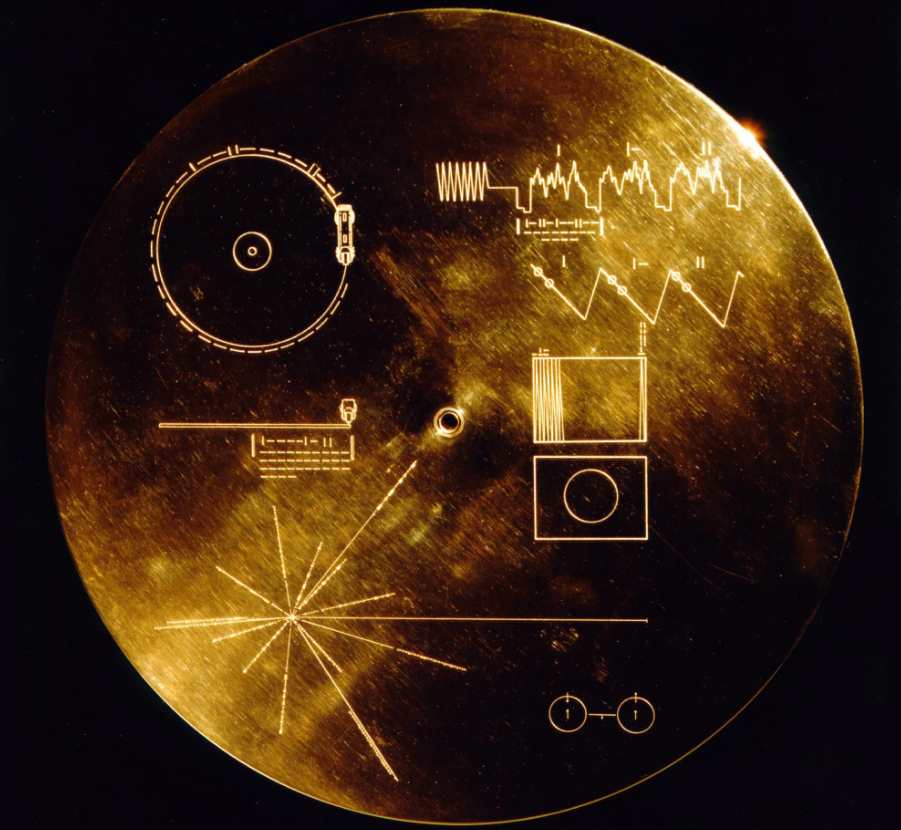
Attached to the spacecraft is a gold-plated copper disc containing sounds and images from Earth. The record includes greetings in multiple languages, music from different cultures, scientific information, natural sounds, and even human laughter. There are recordings of rainfall, Birdsong, Heartbeats, Classical music, Traditional folk songs.
Carl Sagan, one of the most influential astronomers of the twentieth century, helped lead the project. He described the Golden Record beautifully:
“The spacecraft will be encountered and the record played only if there are advanced spacefaring civilizations in interstellar space. But the launching of this bottle into the cosmic ocean says something very hopeful about life on this planet.”
That sentence captures the true meaning of Voyager. The spacecraft is not merely a machine. It is a message. A message saying:
“We existed.” , “We were curious.” , “We tried to understand the universe.”
A spacecraft running on its final energy
Today, Voyager 1 travels through darkness where sunlight is almost unimaginably weak. The spacecraft’s power comes from a radioisotope thermoelectric generator powered by decaying plutonium. Every year, its available energy decreases slightly.
To conserve power, NASA engineers have gradually turned off non-essential systems one by one. Some instruments that operated since the 1970s now remain permanently silent.
Yet Voyager continues surviving against extraordinary odds. In 2024, engineers even recovered communication problems from billions of kilometers away using software fixes transmitted across nearly an entire day of travel time.
The idea itself feels unbelievable:
humans repairing a spacecraft from across interstellar space. And still, Voyager answers. Weakly. Slowly. But faithfully.
At some point in the coming years, the spacecraft’s remaining power will finally become insufficient. One by one, its instruments will shut down permanently. Eventually, Voyager will fall silent forever. But its journey will not end.
Long after Earth changes beyond recognition, Voyager 1 will continue drifting through the Milky Way. Tens of thousands of years from now, it will still move silently between stars carrying fragments of human civilization.
Perhaps no alien intelligence will ever find it. Perhaps nobody will ever hear the Golden Record. Yet strangely, that does not reduce its importance. Because Voyager was never only about discovery. It was about ambition.
At a time when computers were weaker than modern smartphones, humanity launched a machine capable of leaving the Solar System itself. Engineers who designed Voyager used slide rules, primitive simulations, and computers with less memory than a calculator today. Yet they built something that outlived generations.
In an era dominated by rapid technological cycles, Voyager represents a different kind of engineering philosophy — one built on patience, precision, and long-term vision. And perhaps that is why Voyager continues fascinating people even today.
The purest form of human curosity
Not because it is the fastest spacecraft. Not because it is technologically modern. But because it represents one of humanity’s purest scientific achievements:
the desire to go farther simply because we can.
Late at night, when observatories point toward deep space and scientists wait nearly an entire day for signals traveling across billions of kilometers, Voyager reminds humanity of something easy to forget in the noise of modern life.
Most of human existence has been spent looking upward. Wondering what lies beyond the horizon. Wondering whether the universe is empty or alive. Wondering if somewhere, far beyond our tiny planet, another civilization might also be staring into the darkness asking the same questions.
Voyager 1 does not answer those questions. But it carries them farther than humanity has ever reached before. And perhaps that is enough. Because somewhere in the infinite silence between stars, a small spacecraft built by a species from a pale blue planet continues moving forward — carrying humanity’s curiosity into the cosmos long after the hands that launched it are gone.
Even today, decades after its launch, Voyager 1 continues reminding humanity that exploration is not driven only by technology, but by curiosity powerful enough to cross unimaginable distances. In the endless silence between stars, the spacecraft carries something deeply human — the desire to understand what lies beyond the horizon we can currently see.
Perhaps that is why Voyager still feels emotionally different from every modern machine humanity has built. It is old, fragile, and slowly fading, yet it continues moving farther into the unknown with remarkable persistence. Long after its final signal disappears, Voyager 1 will remain a silent ambassador of Earth, drifting endlessly through the cosmos carrying humanity’s curiosity into eternity.